Crypto · three steps, and the one that costs money if rushed
The route that still works when Send is switched off
Maya can buy USDT and cannot move it. So the coin has to be bought somewhere that allows withdrawals. This is the shape of that route, what each step costs in time, and the two mistakes that are expensive enough to be worth a paragraph each.
Why this page exists
Every guide to funding a crypto casino from the Philippines gives two steps: buy the coin in your wallet, send it to the casino. In Maya the first step works and the second does not, for the reason quoted with its date on Maya Crypto.
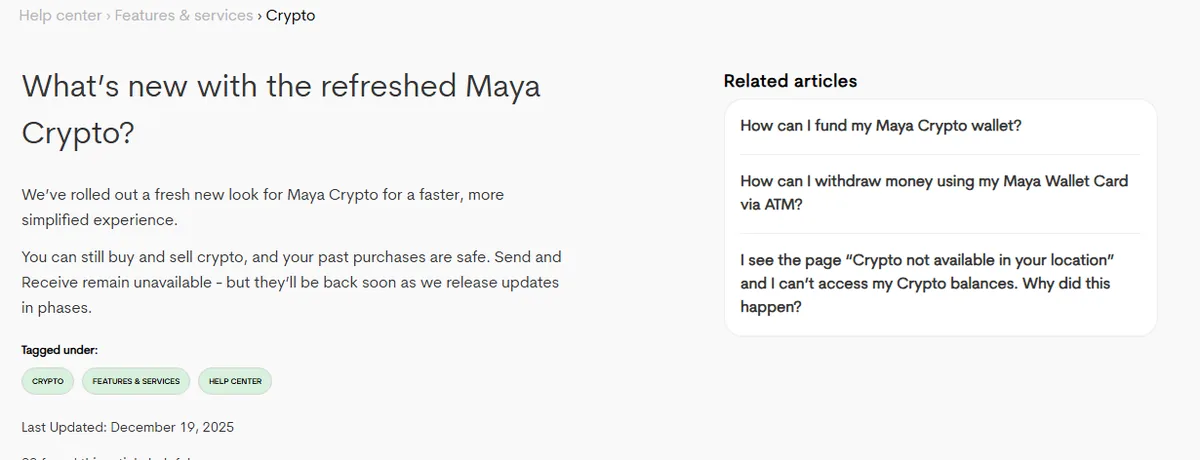
Read the last line before the tags, then read the date under them. Every instruction elsewhere on the internet that tells you to send USDT out of Maya is older than this notice. Screenshot, 24 September 2026
So the route has three steps instead of two, and the extra one is where all the friction lives. Worth saying before anything else: if the game you want is at a Philippine operator that accepts the wallet in pesos, you do not need this page at all — depositing is shorter and cheaper.
Step one: pesos out of Maya
Ordinary rails, nothing exotic. A transfer from the Maya wallet to an account at a licensed exchange, in your own name.
The name matters more here than anywhere else in the chain. An exchange will not credit a transfer from an account in a different name, and unwinding that is slower than every other delay on this page combined. The wallet, the exchange account and eventually the casino account should all carry the same name.
Cost: whatever the transfer channel charges, shown in the app before you confirm. Time: minutes.
Step two: buy the coin where sending is allowed
This is the step Maya cannot do. It needs a venue that supports withdrawals to an external address.
Maya's own help centre is, unintentionally, the best source on which venues those are: it publishes step-by-step guides for sending crypto to Maya from PDAX and Coins.ph, both licensed in the Philippines, and from Trust Wallet. A platform that can send crypto to Maya is a platform that can send crypto, full stop. That is a stronger signal than any list a site like this could assemble.
Two things take the time here:
Verification. First-time identity checks at any licensed exchange are the long pole. Have the ID ready, do it once, and the rest of this route becomes routine.
Choosing the network. USDT exists on several chains. The casino's deposit page names the one it wants, usually with an abbreviation. That abbreviation is the most important word on the screen and it is set in small type.
Cost: the exchange's trading fee plus its withdrawal fee, which differ by network and are shown before you confirm. Time: an evening the first time, minutes after.
Step three: one transfer to the casino
Copy the deposit address from the casino's cashier. Select the same network the cashier named. Send a small amount first.
The test transfer
Send the minimum the casino accepts, wait for it to land, and only then send the rest. It costs one extra withdrawal fee and it is the cheapest insurance in this entire process, for a simple reason: a transfer to the wrong chain is not refused and not reversed. It arrives somewhere, and nobody holds the key. There is no support desk anywhere in the chain that can undo it — not the exchange's, not the casino's, not the wallet's.
People skip the test transfer because it feels like paying twice. It is paying 1% of the amount to find out whether the other 99% has anywhere to land.
Copy, never type
Addresses are copied or scanned, never typed and never trusted to memory. Check the first four and last four characters after pasting. This is not paranoia about the recipient; it is protection against the clipboard, which is the part of a phone most likely to be interfered with by something the owner installed without reading.
What the whole route costs
Four charges, and only the first is the one people budget for.
| Step | What is charged | Shown before you confirm? |
|---|---|---|
| Pesos out of Maya | Transfer channel fee | Yes, in the app |
| Buying the coin | Trading fee, plus the spread | Fee yes, spread no |
| Sending the coin | Network withdrawal fee | Yes, at the exchange |
| Test transfer | One extra withdrawal fee | Yes — and it is deliberate |
The spread is the only line that is never itemised anywhere, on any platform, and it applies just as much to Maya's own no-fee crypto buys as to an exchange's. Comparing the peso figure against the market price at that minute is the only way to see it.
Where the coin can go- USDTone transfer, no peso rail
- No merchant codenothing to be declined
- 21+gambling is a cost, not income
What this page will not do
- It will not name a best exchange. There is no ranking on this site.
- It will not tell you how to reach something that refuses you. If a service
declines, the answer here is that it declined.
- It will not promise a speed. Nobody on this site has timed a transfer, so
there is no figure for one, in minutes or in any other unit.
Coming back the other way
Money returning from a crypto casino comes back as coin, and it arrives at the exchange, not at Maya — because Receive is off at the Maya end too. From the exchange it sells into pesos and goes home by the same rails it left on. The identity-check rules that decide whether that works are on cashing out.
And if the reason you are on this page is that a peso deposit bounced rather than that you wanted crypto, read the decline shapes on depositing first — three of the four are fixable without any of this. The map of all three routes is on maya casino games, and what waits at the end of the route is set out on the games themselves.