The money · the arithmetic nobody does
Fees and limits: three charges, one of them invisible
Three separate parties take something when casino money moves through a wallet, and only two of them itemise it. This page is about telling the three apart, finding the caps that are actually stopping you, and why “no transaction fees” is a true sentence that does not mean what it is quoted to mean.
Three charges, three different parties
When money moves from a wallet into a casino balance, up to three organisations take something, and confusing them is why people's arithmetic never adds up.
The wallet. Maya's own charge on the channel used — cash-in, transfer, card. Shown in the app before confirmation. This is the one people mean when they say “the fee”.
The processor. The company whose name appears on the payment page between the cashier and the app. Its charge is usually built into what the operator shows, sometimes as a percentage of the deposit, occasionally not at all because the operator absorbs it.
The operator. A deposit fee, a withdrawal fee, or a fee after a certain number of withdrawals in a period. This lives in the operator's terms, not in the cashier, which is why almost nobody reads it before the fee appears.
Add them before deciding a maya casino game deposit is cheap or expensive — and before deciding which of the games themselves is worth the charge. One of the three being zero says nothing about the other two.
The charge nobody itemises
Maya's crypto page states there are no transaction fees on buying crypto, and the minimum is ₱1. Both are true.
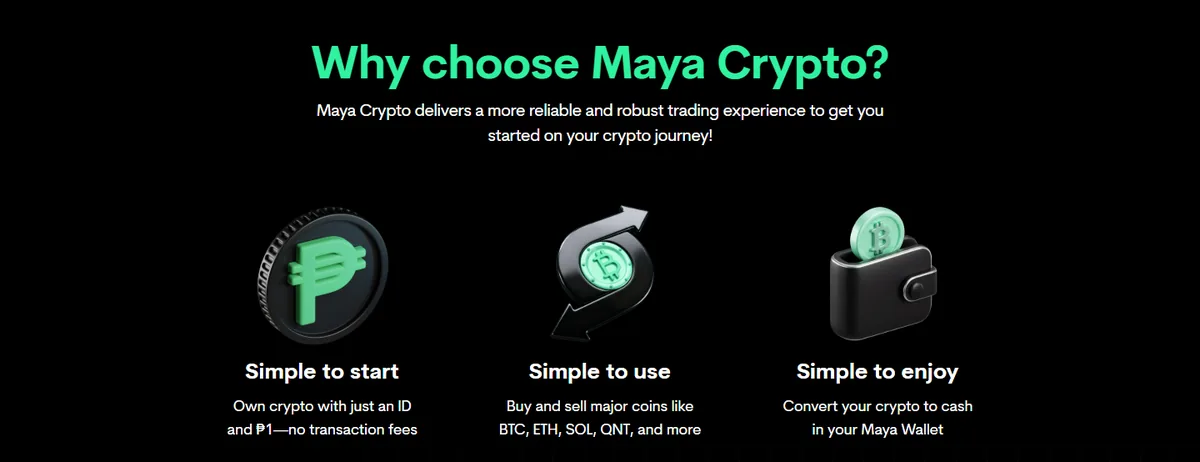
Three claims, all accurate. The third one is the product’s whole shape: converting back to pesos inside the app is the exit, and it is the only exit. Screenshot, 24 September 2026
Neither means the purchase costs nothing.
Any venue that sells you a coin shows a price. The gap between that price and the market price at that second is the spread, and it earns in exactly the way a fee earns while never appearing on a receipt. This is not a Maya criticism — every retail crypto product on earth works this way, and a product with a visible fee and a tight spread can easily be cheaper than one with no fee and a wide one.
The point is only that “no transaction fees” answers a narrower question than the one people ask it. If the real cost matters to you, note the peso amount and the coin amount, and compare the implied rate against the market price at that minute. That figure is the cost. This site does not publish what Maya's spread is, because measuring it properly means repeated observations nobody here has made.
Where the limits actually bite
Four different ceilings exist and they fail in ways that look identical from the outside.
| Ceiling | Where it lives | How it presents |
|---|---|---|
| Per transaction | Wallet, by verification tier | Fails above a figure, works below it |
| Per period | Wallet, by verification tier | Worked earlier this month, fails now |
| Operator minimum | The cashier | Small deposits refused outright |
| Operator maximum | The operator's terms | Large ones split or refused |
The two wallet ones are visible in the app, which shows the remaining allowance. The two operator ones are in the cashier and the terms. Every one of the four produces a decline that looks like a technical failure, which is covered from the other direction on depositing.
A wallet in a lower verification tier is the usual answer when nothing else fits. Raising the tier is an identity check, it takes a day or so, and it removes a class of problem permanently rather than case by case.
Where the coin can go- USDTone transfer, no peso rail
- No merchant codenothing to be declined
- 21+gambling is a cost, not income
What is insured, and what that covers
The support site prints in its header that Maya Philippines Inc. and Maya Bank Inc. are regulated by the Bangko Sentral ng Pilipinas, and that deposits are insured by PDIC up to ₱1 million per depositor.

Worth reading precisely. The insurance covers deposits at the bank if the institution fails. It is not a guarantee about any transaction, and it has nothing to do with a casino balance. Screenshot, 24 September 2026
Worth reading precisely. That insurance is about deposits at the bank — what happens to your money if the institution fails. It is not a guarantee about any transaction, it does not cover a payment you regret, and it has nothing to do with a casino balance, which is not a deposit at a bank in any sense. It is a good fact about where your pesos sit and an irrelevant one about where they go.
Crypto holdings are a separate case again: a balance in the Maya Crypto wallet is not a peso deposit, and the crypto page's own risk wording — that value can rise or fall quickly — is the applicable sentence there. What the crypto side can and cannot do is on Maya Crypto.
Why there are no tables of numbers here
A payments page full of specific figures is the easiest kind of page to write and the fastest to rot. Tiers change, channels change, promotional zero-fee periods start and end, and none of it is announced to the people who copied the numbers.
So this site does two things instead. It tells you which screen shows the current figure — the app, before you confirm, every time. And it dates everything it does quote, so that a reader arriving in six months can see how old the claim is rather than having to assume.
If a number on this site is out of date, the fastest way to change what the next reader sees is contact.
The full picture of what the wallet reaches is on maya casino games, and the comparison people ask for most is on Maya vs GCash.